
Last updated: April 2026 · 6 min read
If you’ve seen headlines about the Employment Rights Act 2025 (ERA) and wondered what it actually means for you as an umbrella company worker, you’re not alone. The good news is that most of these changes are designed to work in your favour, giving you stronger protections from day one, greater transparency over your pay, and more confidence that your umbrella company is operating compliantly. At SmartWork, we want to make sure you understand exactly what’s changing and what it means for your working life.
What it means to be an umbrella company employee
If you work through a compliant umbrella company, like SmartWork, on a PAYE basis, you are legally their employee, not self-employed, and not a contractor working outside the tax system.
That status comes with a clear set of statutory rights that protect you, including:
National Minimum Wage — you are always entitled to at least NMW, regardless of your assignment rate
Statutory holiday pay — you accrue paid holiday entitlement from day one of employment
Statutory Sick Pay — SSP applies where eligibility criteria are met
Auto-enrolment pension — you are automatically enrolled into a workplace pension scheme
Health and safety protections — full employment protections apply to your working conditions
As your employer, the umbrella company operates PAYE on your behalf, deducting Income Tax, National Insurance Contributions (NICs), and pension contributions before paying your net wage. The Employment Rights Act 2025 and updated PAYE rules build on this foundation to make your rights even stronger.
Your day-one employment rights under ERA 2025
ERA 2025 strengthens the rights of workers in temporary and agency-style roles, and that includes umbrella-employed workers like you.
Here’s what changes in practice.
Clear written terms from the start
From the moment your assignment begins, you are entitled to clear written terms covering your role, rest breaks, notice periods, and any probationary conditions. This makes it easier to understand your position and to challenge anything that doesn’t look right.
Unfair dismissal protection after just six months
Previously, workers often had to wait two years to gain full protection against unfair dismissal. Under ERA 2025, that threshold drops to six months in most cases, even for short-term or assignment-based contracts. This means you can’t simply be dropped at the end of a project without proper justification, giving you significantly more security in your role.
Stronger redundancy and parental protections
The Act also enhances safeguards for umbrella workers facing redundancy or those on parental leave. It becomes harder for employers to treat umbrella-employed staff less favourably than directly hired employees when projects end, or roles change, a meaningful step forward for workers in flexible arrangements.
Clearer payslips and stronger protection against deductions
One of the most practical improvements ERA 2025 introduces is greater transparency around pay. If you’ve ever looked at your payslip and felt unsure about how your assignment rate translated into your take-home, these changes are for you.
What your payslip should clearly show
Your itemised payslip must now clearly set out each component of your pay, including your gross assignment rate, Income Tax, employee NICs, pension contributions, and any management margin or fees charged by your umbrella employer.
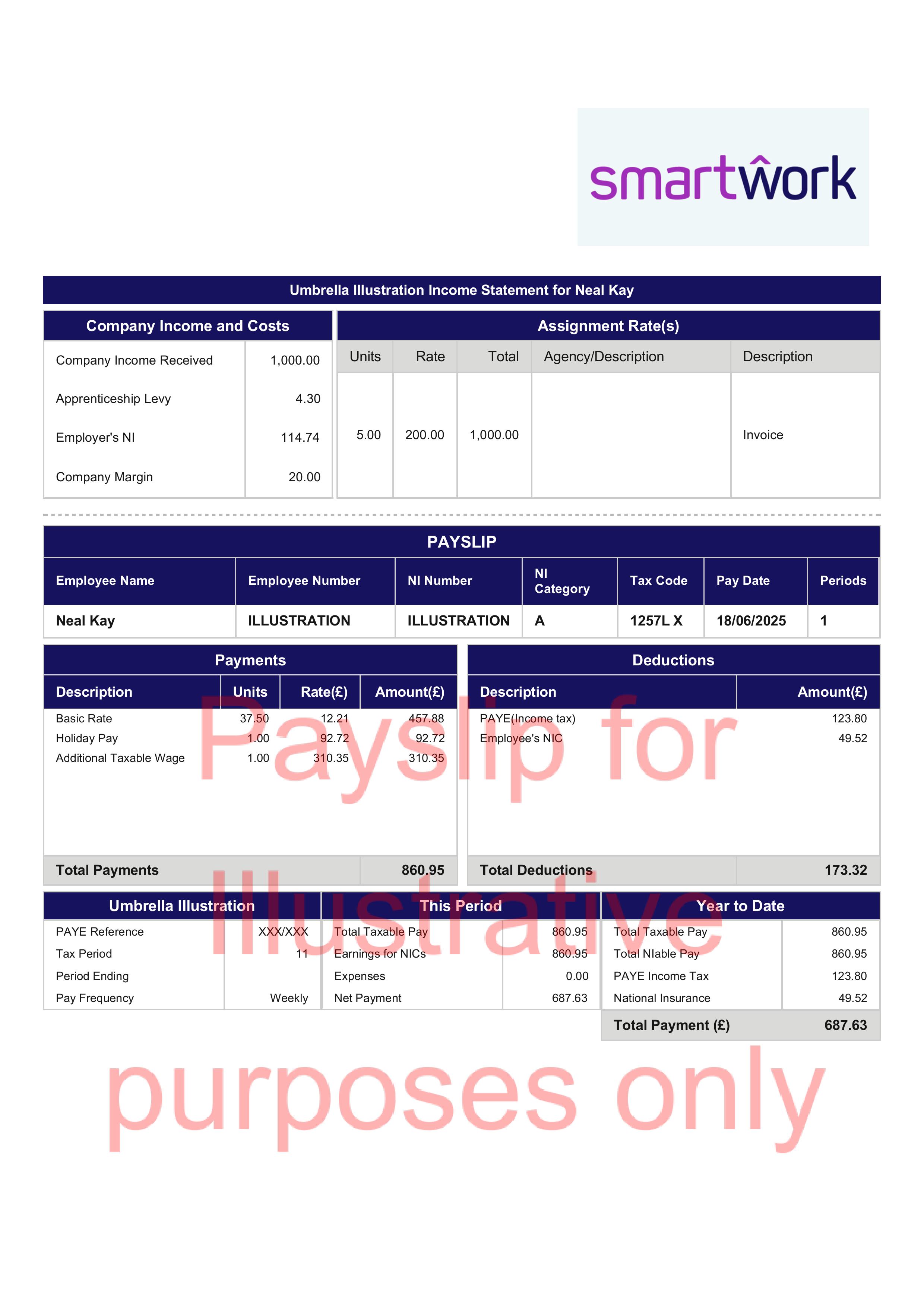
For a complete guide to the SmartWork payslip, please click here.
This level of transparency means you can see exactly how your assignment rate is split between tax, NICs, pension, and our margin. If anything on your payslip is unclear, you are entitled to ask for a full breakdown, and at SmartWork, we’re always happy to walk you through it.
A note on “high take-home” schemes
If another umbrella has promised you an unusually high take-home percentage, it’s worth being cautious. Compliant umbrella companies operate within HMRC’s rules, which means take-home figures above a certain threshold are almost always a sign of non-compliance, and the tax risk ultimately falls on you, not the umbrella.
Stronger rules against unlawful deductions
ERA 2025 more clearly restricts employers from making deductions that are hidden, unexplained, or unlawful. This is particularly relevant in the umbrella sector, where some less scrupulous providers have historically used complex structures to inflate margins or reduce take-home pay in ways workers couldn’t easily spot.
How the April 2026 PAYE changes affect your take-home pay
From 6 April 2026, HMRC has introduced new rules that shift legal responsibility for ensuring PAYE and NICs are operated correctly, moving it up the supply chain from umbrella companies to recruitment agencies and end-clients in many labour-supply arrangements.
For you as an umbrella-employed worker, here’s what this means in plain terms.
Your personal tax treatment stays the same
You will still be taxed under PAYE, with Income Tax and NICs deducted from your pay exactly as before. You don’t need to change how you file or pay tax; nothing changes in your day-to-day experience of being paid.
Less risk of unexpected tax bills
Because agencies and end-clients now carry more responsibility for compliance, they have a strong incentive to use only regulated, compliant umbrella providers. This significantly reduces the chance of a non-compliant umbrella failing and leaving you exposed to an unexpected tax liability; something that has unfortunately affected workers in the past.
A cleaner, more stable market
Agencies are expected to tighten their approved supplier lists in response to these changes, which should gradually push out rogue or high-risk umbrella operators. For workers employed through compliant umbrellas like SmartWork, this can only be a positive development.
How the Fair Work Agency protects umbrella workers
ERA 2025 brings umbrella companies under the same regulatory framework as employment businesses, with oversight from the Fair Work Agency (FWA) and the Employment Agency Standards Inspectorate. This creates clearer routes for workers to raise concerns and get issues resolved.
Greater transparency about your status and fees
Under the new rules, umbrella companies must clearly explain who your employer is, how their fees and margins work, and who is legally responsible for your pay. This reduces the grey areas that have historically caused confusion and, in some cases, harm for workers in umbrella arrangements.
A stronger route to resolve disputes
If you have a dispute over unpaid wages, incorrect deductions, holiday pay, or unfair treatment, the Fair Work Agency can now investigate complaints and take enforcement action against non-compliant employers. You no longer have to rely solely on pursuing your own legal action, a significant improvement for workers who previously had limited options.
What you should do now: a quick checklist
To make the most of your new protections, here are four straightforward steps worth taking:
Check your payslip. Make sure it is clearly itemised with all deductions and any fees shown separately. If anything is unclear, contact your umbrella, and they’ll explain it line by line.
Review your contract. Confirm that it names the umbrella company as your employer and states that you are employed on a PAYE basis. This is the foundation of all your statutory rights.
Ask your agency about compliance. It’s reasonable to ask how your recruitment agency plans to meet the April 2026 PAYE-responsibility rules and whether they have a list of approved, regulated umbrella providers.
Know how to raise a concern. If you ever feel your pay, deductions, or working conditions aren’t right, raise it with the umbrella company directly, or contact the Fair Work Agency if you feel the issue isn’t addressed.
In summary
As an umbrella employee, the Employment Rights Act 2025 and the updated PAYE regime from April 2026 are designed to work in your favour:
Stronger rights — day-one protections, earlier unfair dismissal cover, and better parental and redundancy safeguards
Pay transparency — itemised payslips and stricter rules against unlawful or hidden deductions
Reduced risk — agencies and clients now share compliance responsibility, reducing your exposure to rogue umbrellas
Better enforcement — the Fair Work Agency gives you a clearer, supported route to resolve any disputes
Why choose SmartWork as your umbrella company?
Navigating the changes introduced by ERA 2025 is much easier when you have the right umbrella company behind you. SmartWork is a fully compliant PAYE umbrella employer — but what sets us apart is the personal service we provide to every one of our employees.
When you join SmartWork, you are assigned a dedicated business manager who is your single point of contact for everything: from understanding your payslip and checking your contract, to answering questions about how the new rules apply to your specific assignment. You’ll always speak to someone who knows you and your situation — not a generic helpdesk.
Don’t just take our word for it. SmartWork is rated 5.0 stars on Google and 4.9 stars on Trustpilot by the contractors and workers we support every day, reflecting the care and attention we put into every employee relationship.
If you’re looking for an umbrella company you can trust to keep you compliant, keep you informed, and always pick up the phone, SmartWork is here for you.
Ready to find out more?
Get in touch with our team today, and we’ll assign you a dedicated business manager who can walk you through everything — from your first payslip to the latest employment law changes.